

Destination weddings
We will bring the baraat to you
Book UK drummers and dhol players for a wedding abroad. How the kit travels, who books the flights, what the paperwork needs and what an all-in quote covers.
Proof
Where we have played
Why fly a group out
Dhol players for your destination wedding
Book Locally
The question every couple asks, and it deserves a straight answer rather than a sales one: a local player is cheaper, and for some events a local player is the right call. What you lose is everything that is not the playing.
A group that has worked together for years knows the shape of the day without being told it — where the baraat actually starts, how long the walk really takes, when to lift and when to drop back so the family can hear each other. That is not repertoire, it is a hundred weddings of shared shorthand, and it is the part that cannot be arranged over email in a second language the week before.
What You Are Actually Booking
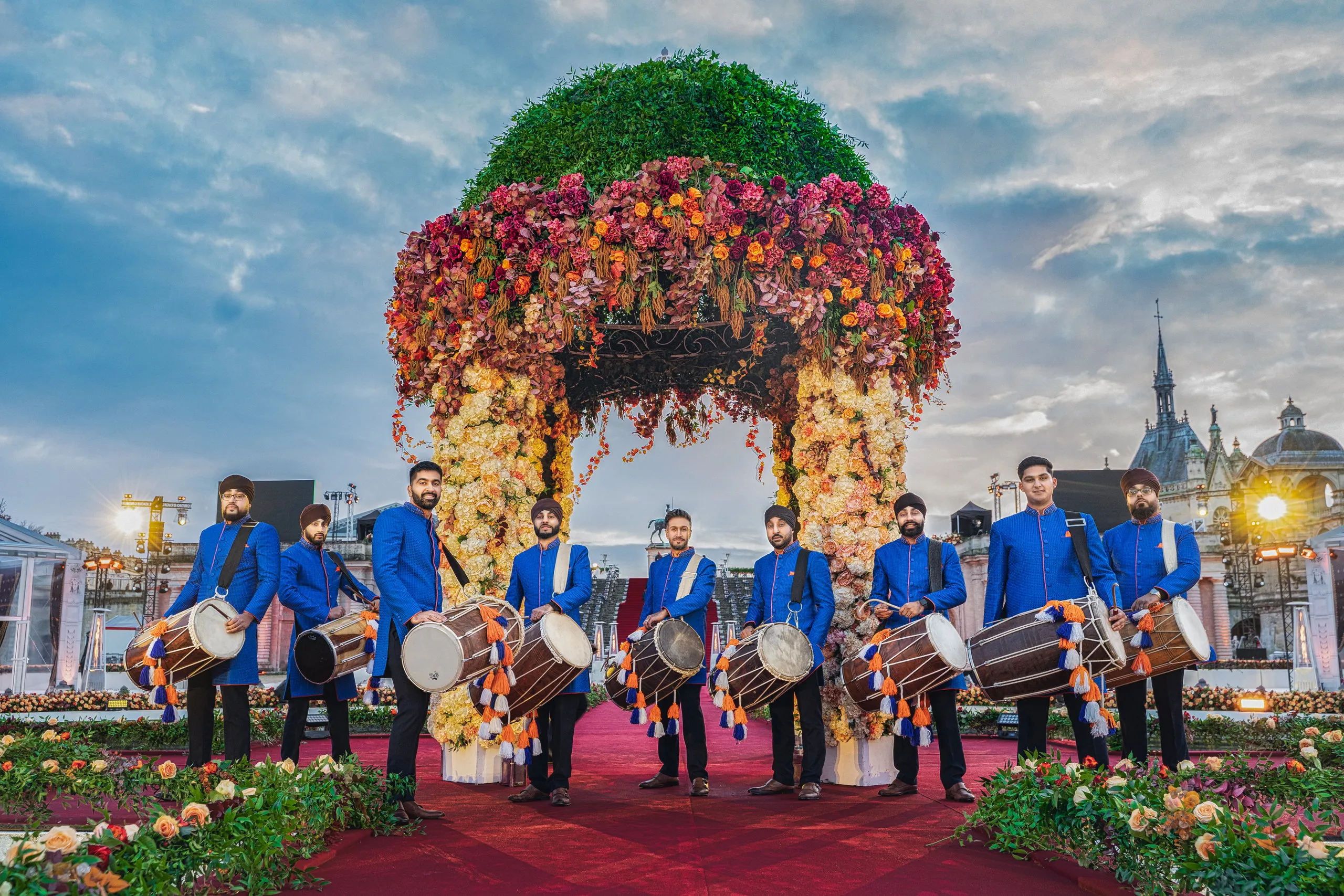
The people in the footage are the people who land. There is no roster, no substitution on the morning, and no gap between what you watched and what turns up. For a day that cannot be re-run, that predictability is most of the value.
What We Are Not
We will not undercut a local player on price and we will not pretend to. Flying a group, its kit and its paperwork to another country costs what it costs, and the figure you are quoted includes all of it rather than discovering it later.
Where the Real Work Is
Almost none of the difficulty in a wedding abroad is musical. It is cases, weights, customs, permits, insurance wording and the buffer you build in case an aircraft goes technical. That is what the next section covers, in detail, because it is what nobody else in this category will put in writing.
The practical answers
The practical answers
The practical answers
How the drums travel
The dhol and full kit travel as checked hold luggage on the same flight as the players — never shipped separately as freight, and never left to arrive on a different day. Cases are packed to the airline's own hold-luggage dimensions and weight limits, checked against the specific carrier before the flight is booked, because these vary more than people expect. A kit list is sent to the airline in advance where the carrier asks for one, so nothing gets held at check-in on the day. If a venue needs the instruments delivered ahead of the group for a rehearsal or soundcheck, that's arranged separately and confirmed in writing — never assumed.
Flights and accommodation
We book our own flights and our own accommodation — you're never asked to arrange travel for us, and we're never a line item you have to chase separately. The cost of both is folded into one quoted figure agreed before the date is held, calculated at the actual cost of getting the group there and back, not marked up. Flights are booked once the date is confirmed, timed to land with enough buffer for a delayed connection to still make the performance slot. Accommodation is booked for the minimum nights the trip genuinely needs — never padded to inflate the quote — and confirmed to you or your planner in writing.
Visas, permits and carnets
What's needed depends entirely on the destination, and we check it against your date as soon as it's booked rather than in the final weeks. Some countries need nothing beyond a valid passport for every player. Others require a performer's visa, a work permit, or an ATA carnet for the instruments — a customs document that lets the kit cross the border temporarily without import duty, and has to be applied for with lead time. We tell you plainly which of these your destination needs, arrange them ourselves, and confirm they're in hand well before you'd have any reason to ask.
What happens if a flight is cancelled
International dates carry a built-in buffer — we fly a day earlier than strictly necessary specifically so one cancelled or delayed flight doesn't put the booking at risk. If a flight is cancelled outright, the next available option is booked immediately and you're told the same day, not left to find out from us later. For dates where the buffer alone isn't enough insurance against disruption, we agree a contingency in writing before the date is confirmed — what happens, who decides, and at what point a local backup plan gets discussed. Nothing here is worked out for the first time on the day it happens.
Lead time
Nine to eighteen months ahead is typical for a destination booking, in line with how far in advance most international venues are themselves booked, and it gives enough runway to sort flights, visas and carnets properly rather than rushed. That said, shorter notice is still worth asking about — availability depends on the date and destination more than a fixed rule, and we'd rather give a straight answer than a blanket no. The one thing lead time genuinely affects is cost: a later booking means less choice on flights, which can push the travel portion of the quote up.
Insurance abroad
UK public liability cover does not automatically extend to a performance abroad, so we check it per country rather than assume it carries over. Where it does extend, we confirm that in writing before the date is held. Where it doesn't, we arrange the cover the destination actually requires, and the certificate is sent to your venue directly, the same way it would be for a UK booking. Ask us for the specific country and we'll tell you plainly whether cover applies, rather than a vague reassurance that it's "sorted" — this is exactly the kind of detail we'd want confirmed in writing if we were the ones booking.
Work from abroad
 Watch
Watch Watch
Watch Watch
Watch Watch
Watch- Watch
- Watch
Questions about travelling
Can the drums actually go on a plane?
Yes — they fly as oversized hold baggage in hard flight cases, booked in advance with the airline rather than argued about at the desk. The cases are built for it, the heads are slackened for the pressure change, and the whole set is checked and re-tuned at the venue rather than assumed to have survived.
Who books the flights and the accommodation?
Either of us can, and it is agreed before anything is confirmed. What matters more than who clicks the button is that it is costed into the one figure you are quoted, so the travel does not reappear as a separate invoice afterwards.
What happens if a flight is cancelled?
We travel the day before at the latest, so a cancellation costs a night rather than the wedding. That buffer is the plan — a same-day flight to your own wedding is not a plan, and anyone who tells you otherwise is describing a risk they are asking you to carry.
Do you need visas or a carnet for the kit?
It depends entirely on the country, and it is checked before a date is held rather than in the last month. Some destinations need nothing beyond a passport; others need a performer permit, an equipment carnet, or both, and each has its own lead time.
Is your insurance valid abroad?
Ask us for the specific country and we will tell you straight, in writing. Cover that applies in the UK does not automatically extend everywhere, so the honest answer is per-destination rather than a blanket yes — and your venue will want the certificate either way.
How much notice do you need for a wedding abroad?
Nine to eighteen months is the window most couples are already working in, and it suits this well. Inside three months it becomes a question of flights and paperwork lead times rather than availability, so it is worth asking even when the date feels close.
How many players travel, and how many nights do you need?
Whatever number is on your booking, and usually two nights. Arriving the day before is what makes the travel-day buffer real, and leaving the morning after means the set can run to its proper end rather than to a taxi.
What if our country is not listed?
Ask, and we will tell you straight whether we can do it properly. The countries shown on this page are ones with real work behind them; a country missing from the list is not automatically a no, it just means we have not been yet.
Tell us where you are getting married
Send us the date and the venue and we will come back with one all-in figure.